Runtime settings
Everything an operator may want to change while the platform runs is a runtime setting: typed, grouped in sections, stored in PostgreSQL and hot-reloaded on every replica. Environment variables are reserved for what the process needs before it can reach the database.
Three layers
The effective value of a field is taken from the strongest layer that defines it:
| Layer | Source | Changed by |
|---|---|---|
| 1. Code defaults | The section classes in the backend. | A release. |
| 2. Deployment file | The YAML file named by IDEKUBE_SETTINGS_FILE. The chart renders it from the values it derives (see Install) merged with the settings: value, and mounts it at /etc/idekube/settings.yaml. | helm upgrade. |
| 3. Operator overrides | Rows in the settings table, written through the Settings page or PATCH /v1/settings/{name}. | An account with settings:write. |
Layers are merged per top-level field of a section. Overriding teams.personal_quota or auth.providers replaces that whole field; fields the operator never touched keep following the deployment file.
An override stays until it is removed: send null for a field to drop its override and return to the deployment value.
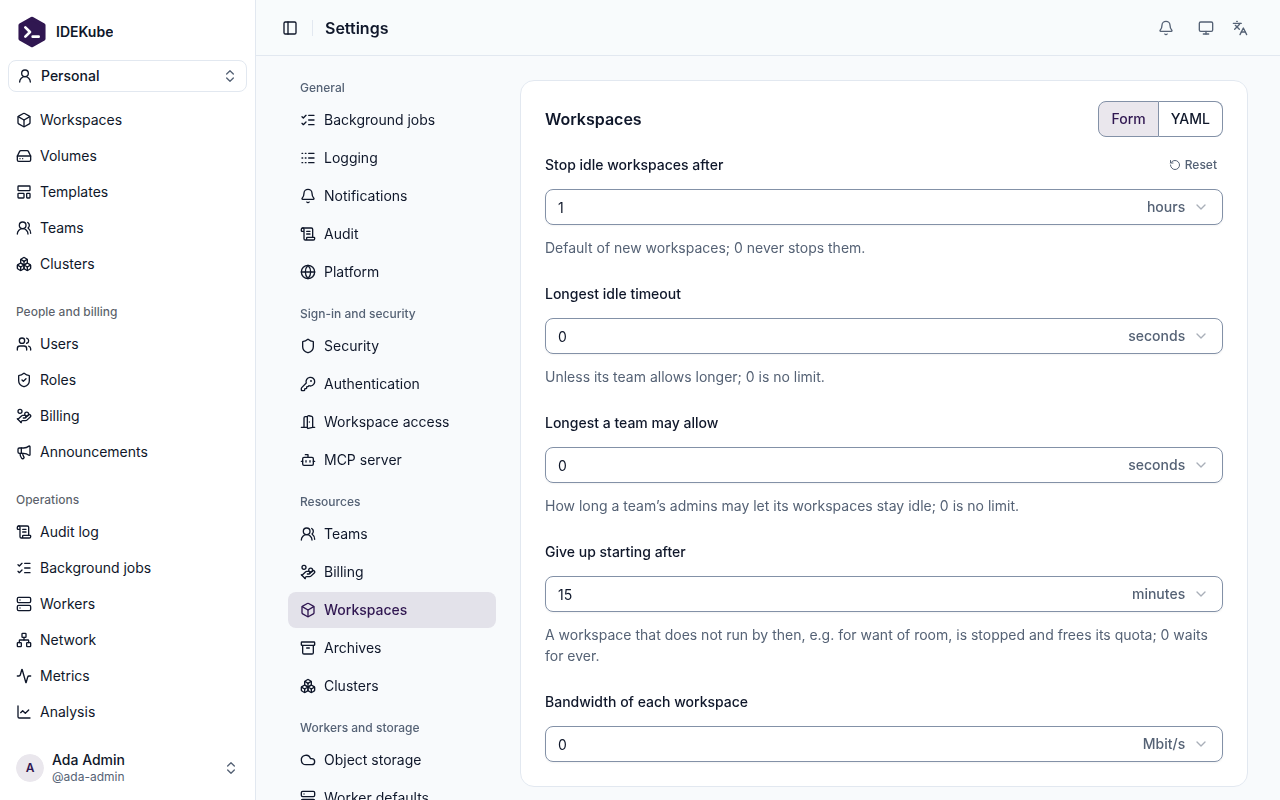
The Settings page, under Platform, edits each section as a form, or as YAML.
Example of the chart's settings: value:
settings:
  worker:
    registry_mirrors:
      docker.io: registry.internal/dockerhub
  teams:
    personal_quota: {workspaces: 5, cpu_m: 8000, memory_mb: 16384, storage_mb: 51200, gpu: 0}
The Settings page
The page lists the sections in groups, each by its icon, and shows one as a form: numbers in a unit you pick, such as minutes or GiB, the fields few need folded under Advanced, and lists of objects, such as the volume classes, as rows or as a list whose items open beside it. A field set here shows Reset, which drops its override. YAML shows the whole section as YAML, to read or edit at once. Changes apply once saved.
Hot reload
A change through the API takes effect on the replica that handled it as soon as the request commits. That replica publishes a notification on Valkey and the others reload immediately. Every replica also reloads every 30 seconds, which covers a lost notification and picks up changes to the deployment file without a restart.
A section whose stored or deployed settings no longer validate, after an upgrade or a mistake in the deployment's file, keeps the value it had (its defaults on a replica that just started) and says why: on the Settings page, in GET /v1/settings as problem, and in the log. Replicas start all the same.
API
GET /v1/settings(settings:read) returns every section with itsname,title, the JSON Schema of its value (json_schema), the effectivevalue, the fields set through the API (overridden) and, when what is set does not validate, itsproblem.PATCH /v1/settings/{name}(settings:write) merges the request body into the section's top-level fields. An invalid value is rejected with422and codeinvalid.
Secrets are returned as **********. Send the mask back unchanged to keep the stored secret; items of a list are matched by their name.
curl -X PATCH https://idekube.example.org/v1/settings/workspaces \
  -H "Authorization: Bearer $TOKEN" -H 'Content-Type: application/json' \
  -d '{"idle_timeout_s": 7200}'
Unknown fields in the deployment file or in a patch are ignored.
Sections
platform
| Field | Default | Meaning |
|---|---|---|
external_url | "" | Public URL of the web UI, for example https://idekube.example.org. Required for single sign-on callbacks and to send visitors of a workspace to sign in. |
cdn_url | "" | Optional http:// or https:// CDN origin URL (without a trailing slash, e.g. https://cdn.example.com) used to prefix public static asset URLs such as branding images (/v1/branding/images/*) and user avatars (/v1/users/*/avatar). Empty serves them directly from the platform origin. |
site_name | IDEKube | Name shown by the UI. |
announcement | "" | Text shown on the sign-in page. |
When cdn_url is set, point your CDN distribution's origin at the IDEKube API server (forwarding /v1/branding/images/* and /v1/users/*/avatar with the v query parameter included in the cache key) and serve the CDN over https:// so it satisfies the frontend's Content-Security-Policy (img-src 'self' data: blob: https:). Both public asset endpoints emit strong ETag / 304 Not Modified, immutable Cache-Control: public, max-age=31536000, immutable on matching ?v= requests (and public, max-age=60, must-revalidate for unversioned or stale requests), plus Access-Control-Allow-Origin: *, Cross-Origin-Resource-Policy: cross-origin, Vary: Origin and X-Content-Type-Options: nosniff. Authenticated endpoints remain private and are never prefixed with cdn_url.
auth
| Field | Default | Meaning |
|---|---|---|
password_login | true | Allow sign-in with a password. Accounts that hold settings:write can always sign in with a password, even when this is off. |
access_token_ttl_s | 900 | Lifetime of an access token. |
refresh_token_ttl_s | 604800 | Lifetime of a refresh token (7 days). |
providers | [] | Identity providers. See Single sign-on. |
teams
| Field | Default | Description |
|---|---|---|
personal_quota | {workspaces: 10, cpu_m: 8000, memory_mb: 16384, storage_mb: 51200, gpu: 0} | Quota of personal teams without their own. See Quotas. |
team_quota | same | Quota of shared teams without their own. |
max_owned_teams | 3 | Shared teams one account may own; holders of team:manage are not limited. |
billing
| Field | Default | Description |
|---|---|---|
enforce | false | Refuse compute to teams without credit and stop what they run. See Billing. |
prices | all 0 | Credits per unit and hour: cpu_core, memory_gib, storage_gib, gpu, and accelerators per class. |
initial_credits | 0 | Granted once to every new team. |
personal_policy, team_policy | no allowances, no limits | Default credit policy of personal and shared teams. |
warn_hours | 24 | Tell a team's owners when its credit lasts less than this at what it spends now; 0 tells nobody. |
storage_grace_days | 14 | How long a team without credit keeps using its volumes; past that they are frozen, kept and charged, but neither made nor grown, until it has credit again. 0 never freezes them. |
jobs
| Field | Default | Description |
|---|---|---|
concurrency | 4 | Jobs one replica runs at the same time. See Background jobs. |
retention_days | 14 | Finished jobs older than this are deleted. |
workspaces
| Field | Default | Meaning |
|---|---|---|
idle_timeout_s | 3600 | Default idle timeout of new workspaces. 0 never stops them. |
idle_timeout_max_s | 0 | The longest a workspace may stay idle, unless its team allows longer. 0 is no limit. |
team_idle_timeout_max_s | 0 | The longest a team's admins may let its workspaces stay idle. 0 is no limit. |
start_timeout_s | 900 | How long a workspace may take to start, e.g. waiting for room on its worker; past that it is stopped and its quota freed. 0 waits for ever. |
Where workspaces are served is a property of their worker: its agent reports the domain and scheme it was installed with.
access
How people reach running workspaces. See Workspace access.
| Field | Default | Meaning |
|---|---|---|
session_ttl_s | 43200 | Lifetime of the session cookie on a workspace host (12 hours). |
activity_bytes | 8192 | Bytes a workspace must exchange through its gateway within half a minute to count as in use. See Activity. |
mcp
The MCP server section: what AI agents are offered at /v1/mcp. An agent is never offered more than its token and its permissions allow. These fields do not reach idk mcp serve, which runs on the person's own machine.
| Field | Default | Meaning |
|---|---|---|
enabled | true | Serve /v1/mcp; off, it answers 403 and mcp_disabled. |
read_only | false | Offer only the tools that read, even to tokens with full access. |
allow_admin_tools | true | Offer the administrators' tools, such as admin_query_audit, to holders of the permissions they read with. |
allow_workspace_files | true | Offer the tools that read and write the files of running workspaces. |
worker
The settings of every worker. A worker's own overrides, set on its page, replace whole top-level fields.
| Field | Default | Meaning |
|---|---|---|
image_pull_policy | IfNotPresent | Always or IfNotPresent, for workspace containers. |
image_pull_secrets | [] | Names of pull secrets in the workspaces namespace. |
registry_mirrors | {} | Registry host to mirror prefix. See Air-gapped installs. |
cpu_overcommit | 10 | How many times the cluster's CPU the limits of running workspaces may add up to. Each workspace requests its limit divided by this from the scheduler. |
memory_overcommit | 4 | The same for memory. Above 1, a workspace may be killed for memory another one uses. |
node_selector | {} | Node selector of workspace pods. |
accelerators | one class, nvidia | Device classes templates may request: name, title, extended resource, RuntimeClass, node selector and tolerations. See Templates. |
runtimes | [] | RuntimeClasses templates may name. |
volume_classes | one class, standard | Kinds of storage volumes are created in; the first is the default. See Storage. |
networks | [] | Multus NetworkAttachmentDefinitions templates may attach workspaces to. Reserved: not yet tested with Multus. |
sidecar.image | the release's | Image of the sidecar next to every workspace; the chart sets that of its release. A workspace keeps the one it started with. |
sidecar.run_as_user | 1000 | User the sidecar runs as: that of the workspace images. |
dns | kube-system, k8s-app: kube-dns | The cluster's DNS servers: the namespace and labels of its DNS pods, and cidrs for servers outside them, e.g. a node-local cache at 169.254.20.10/32. A workspace whose network is restricted reaches them alone on port 53. |
agent.auto_upgrade | false | The worker's agents roll themselves out to the control plane's release, where their chart allows it (agent.selfUpgrade); see Upgrades. |
agent.image | "" | The image they upgrade to; empty is theirs, at the control plane's release. |
object_storage_endpoint | "" | Where the worker's workspaces reach the object store, when not at its endpoint. See Object storage. |
Agents receive changed settings within seconds. A workspace takes them when it next starts: a running workspace is never restarted for a change of the worker's settings, nor for a new agent release. Volumes take them when next reconciled.
object_storage
The S3-compatible store plugins keep files in. See Object storage.
| Field | Default | Meaning |
|---|---|---|
endpoint | "" | The store's URL; empty turns it off. |
region | us-east-1 | The region requests are signed for. |
bucket | "" | The bucket, which must exist. |
prefix | "" | What every key starts with, e.g. idekube/. |
access_key, secret_key | "" | The credentials; the secret is never shown again. |
path_style | false | Name the bucket in the path rather than the host. |
audit
| Field | Default | Meaning |
|---|---|---|
retention_days | 180 | Audit records older than this are deleted; export them first to keep them. See Observability. |
security
| Field | Default | Meaning |
|---|---|---|
client_ip_source | x_forwarded_for | Where the client's address is read from behind trusted proxies: x_forwarded_for, cf_connecting_ip, x_real_ip, true_client_ip, or custom. |
client_ip_header | "" | Custom HTTP header name when client_ip_source is custom, e.g. Fly-Client-IP (X-Forwarded-For is rejected). |
trusted_proxies | private ranges | Networks of the proxies in front of the API, honoured for client IP headers and X-Forwarded-For. |
address_requests_per_minute | 3000 | Requests per client address; 0 does not limit. |
credential_requests_per_minute | 600 | Requests per token; 0 does not limit. |
account_failures, address_failures, failure_window_s | 5, 30, 900 | Guesses of passwords and codes allowed per account and per address. |
captcha | provider: off | Human verification: provider (off, turnstile), mode (failures, always), and provider settings such as turnstile.site_key and turnstile.secret_key. |
See Security.
logging
| Field | Default | Meaning |
|---|---|---|
level | "" | Overrides the level the server starts with. |
access_log | errors | off, errors or all. |
slow_request_ms | 2000 | Requests taking longer are logged as slow. |
See Observability.
Other sections
The sections of the modules with pages of their own are described there: notification in Notifications, backup in Backups, network in Network, cluster in Clusters, and those of the plugins, such as git and canvas, in Git and Canvas.
Process configuration
These environment variables are read once at start. The chart sets them; they matter mostly for development.
| Variable | Default | Meaning |
|---|---|---|
IDEKUBE_DATABASE_URL | postgresql://idekube:idekube@127.0.0.1:5432/idekube | PostgreSQL connection. |
IDEKUBE_VALKEY_URL | valkey://127.0.0.1:6379/0 | Valkey connection. |
IDEKUBE_SECRET_KEY | an insecure development key | Signs access tokens and workspace sessions. |
IDEKUBE_PREVIOUS_SECRET_KEYS | unset | Keys the secret key replaced, newest first, comma-separated: what they signed or sealed is still accepted, so a key can be replaced without signing everyone out. |
IDEKUBE_HOST, IDEKUBE_PORT | 0.0.0.0, 8080 | Listen address. |
IDEKUBE_LOG_LEVEL, IDEKUBE_LOG_JSON | INFO, false | Logging. |
IDEKUBE_SETTINGS_FILE | unset | Path of the deployment settings file. |
IDEKUBE_BOOTSTRAP_ADMIN_USERNAME, IDEKUBE_BOOTSTRAP_ADMIN_PASSWORD | admin, unset | First administrator, created by idekube migrate. Without a password one is generated and logged once. |
IDEKUBE_BOOTSTRAP_WORKER_TOKEN | unset | Token of the worker local, set by idekube migrate. The chart sets it to the one it gives the local worker's agent. |
IDEKUBE_REPLICA | host name | Name this replica reports in GET /v1/system. |